IMPORTANT NOTE FOR USERS OF ACTIVE ANTENNAS
Radiated emissions measurements are sometimes made with active antennas. Some of these antennas are not compatible with Sonoma Instrument amplifiers and are likely to damage them. Please read this document to familiarize yourself with the problem and prevent damage to your amplifier.
An active antenna consists of an antenna element and a battery powered built-in amplifier. Theoretically, there should be no need for an external amplifier, but in practice some users prefer additional gain. The incompatibility with some active antennas arises from the switching transients produced by the active antenna when it's powered on or off. The transient signals from one such antenna are shown below. Figures 1 and 2 show the antenna output voltage. The vertical scale is set to 2 V/div. The switching transients shown below are by no means the strongest examples available.
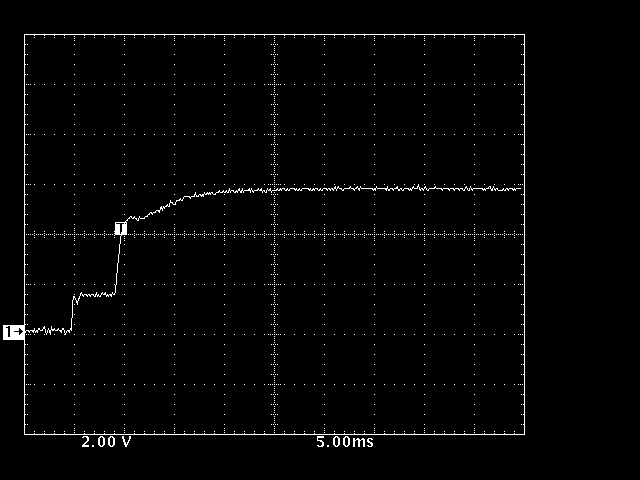
Fig. 1 The power-on transient reaches almost 6 Volts.
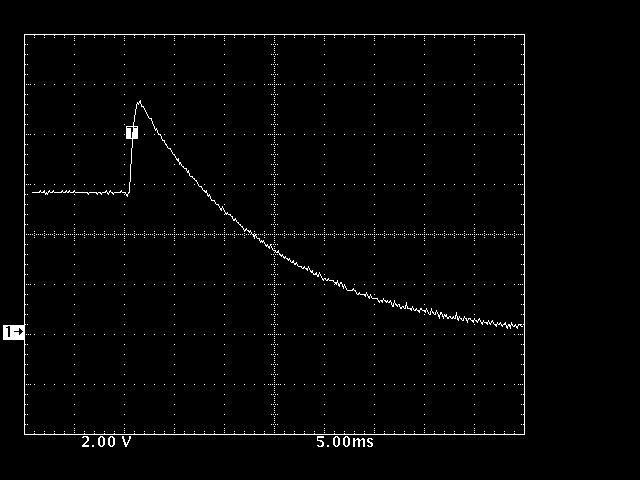
Fig. 2 The power-off transient adds another 3 Volts to the previous transient, for a total of 9 Volts at the peak.
It is in theory possible to use a sequence of power-up and
power-down procedures which will shield an amplifier from
transients. In practice, it's difficult to assure that these
procedures will always be followed. Some protection can be
provided by a power limiter such as the
Keysight
Technologies 11867A.
Active antennas are not recommended for use with Sonoma Instrument
amplifiers, except in conjunction with a protective device such as
a power limiter. Damage caused by excessive
signal levels at the amplifier's input and output ports is not covered under the warranty.